The genetics of eye color
Eye color is one of the most-asked questions in any pregnancy group, and it is also one of the most misunderstood. The old school rule was simple: brown is dominant, blue is recessive, end of story. Real genetics is richer than that. The color of the iris depends on a protein called melanin — the same pigment that colors skin and hair — and the amount of melanin in the front layer of the iris is what makes an eye appear brown, hazel, green, grey or blue. Brown eyes are simply irises with a lot of melanin; blue eyes have very little; green and hazel sit in between with a mix of structure and pigment.
Two genes do most of the heavy lifting. OCA2 produces a protein that controls how much melanin is made, and HERC2 acts like a switch that turns OCA2 on or off. Together they explain a large share of the variation in human eye color. Because these genes come in two copies — one from each parent — and because the 'high melanin' versions are dominant over the 'low melanin' versions, we can build a simplified probability table from the parents' own eye colors. That is exactly what our Eye Color Predictor does, using the classic teaching model that brown outranks green, and green outranks blue.
It is worth saying clearly that dozens of other genes contribute small effects, which is why two blue-eyed parents occasionally (about one in a hundred in large population studies) have a brown-eyed child. The simplified model cannot capture every surprise, and no tool should pretend otherwise. What the predictor gives you is a statistically reasonable starting point, not a guarantee.
Why so many newborns have blue eyes
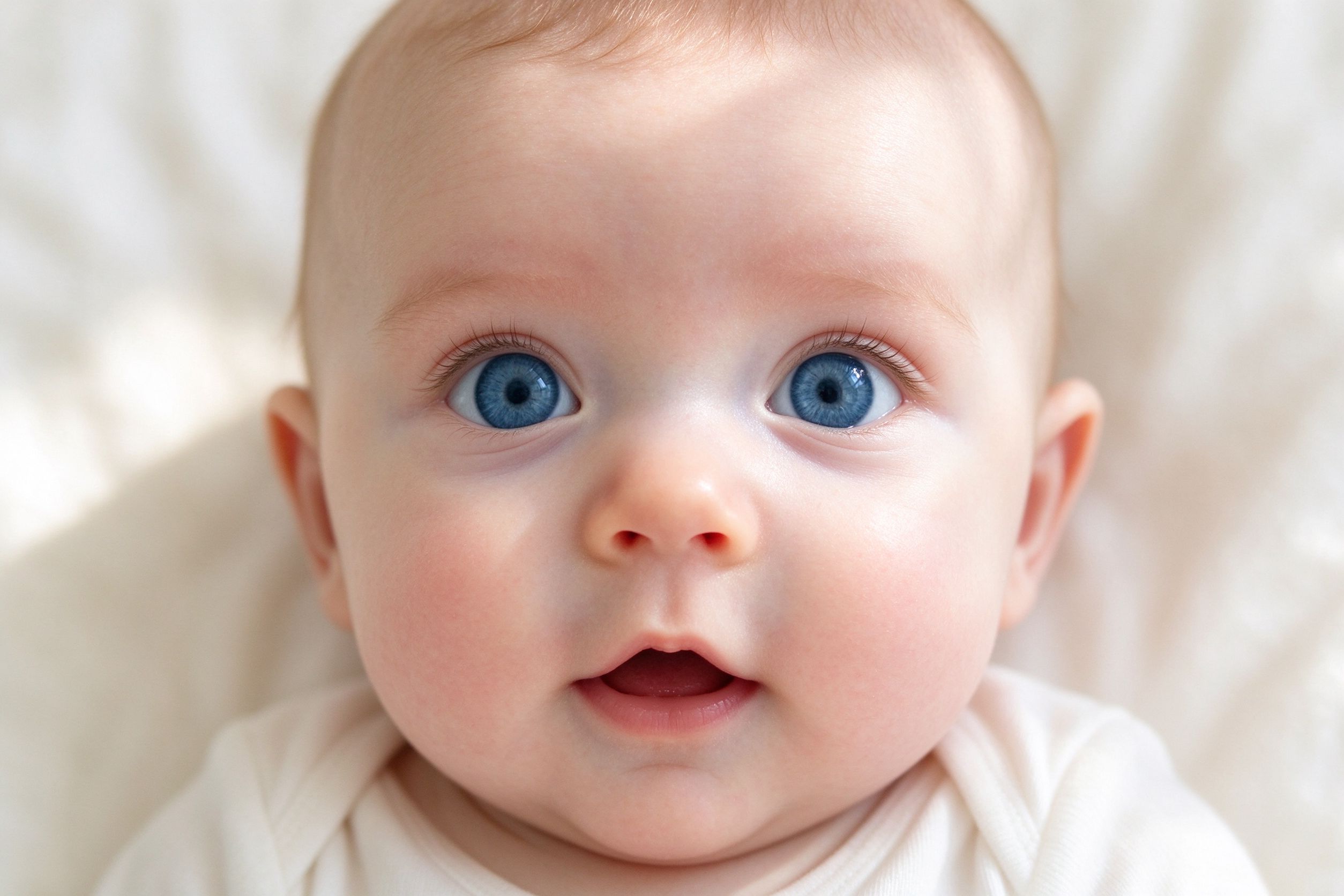
Walk through any maternity ward and you will see rows of blue-eyed babies — even in families where everyone has brown eyes. The reason is not genetics; it is timing. At birth, melanin production in the iris has barely begun. Most babies are born with light, grey-blue eyes simply because very little pigment has formed yet. Over the first six to twelve months, the melanin machinery slowly wakes up, and the iris darkens to its true color.
This is the single biggest reason people say 'the predictor was wrong.' It was not wrong about the likely adult color — it was compared against a baby's temporary birth color. If your baby was born with steel-blue eyes and both parents have brown eyes, the most likely outcome remains brown, but you will simply have to wait months to see it. Only around ten percent of babies keep changes going past their first birthday, and a tiny minority keep subtle shifts until age two or three.
The practical lesson: run the predictor, enjoy the result as a fun projection, and remember that the baby book photo at birth is a snapshot of a work in progress, not the final portrait.
Reading the probability table
Our tool takes the mother's and father's eye colors and returns three probabilities. Let us walk through the most common combinations. Two brown-eyed parents: the classic table says about 75% brown, 18.75% green and 6.25% blue — the green and blue possibilities exist because both parents may be silently carrying lighter versions of the pigment genes. One brown-eyed and one blue-eyed parent: roughly 50% brown, 50% blue in the simple model, with a small green possibility if the brown-eyed parent carries a green variant.
Two green-eyed parents: about 75% green and 25% blue, with brown essentially off the table unless a hidden brown gene is lurking. Two blue-eyed parents: about 99% blue in the simplified model — which is why the rare brown-eyed child of two blue-eyed parents makes headlines. Green-eyed parents with one blue-eyed partner: roughly 50% green and 50% blue.
Notice that the biggest numbers (the 'likely' result) tell you which color is most probable, while the smaller numbers tell you the room for surprise. That is how a responsible predictor works: it communicates uncertainty instead of hiding it.
How accurate is it, honestly?
Here is the honest answer: for the most common combinations, the simplified model lines up well with what population genetics predicts, and it matches most families' experience. But 'most' is not 'all'. Studies of large populations have shown that eye color is influenced by at least sixteen genes beyond OCA2 and HERC2, with effects ranging from tiny to noticeable. Genetic ancestry also matters: certain variants are more common in some regions, shifting the odds.
That means our percentages are best treated as rounded, illustrative probabilities — great for satisfying curiosity at a baby shower, not for making medical or legal decisions. The only way to know a child's eye color with certainty is to wait for it to develop, or to run an actual genetic test. We deliberately keep the language playful on the tool page ('brown is dominant, surprises happen') because that is the truthful tone for a project of this nature.
If you want a deeper dive into the science, our companion guide 'Baby Blood Type Predictor: ABO & Rh Inheritance Made Simple' shows the same genetic logic applied to blood groups, where the rules are even cleaner.
How to get the most from the tool
Use it as a conversation starter, not a fortune teller. At a gender reveal or baby shower, predicting eye color is one of the most engaging games in the room — everyone has an opinion, and the odds table makes the debate friendly. If both sides of the family swear 'the eyes are always green in our family', run the combination twice: once with the stated colors and once with the grandparents' colors, and compare.
Pair the predictor with our Hair Color Predictor and Trait Dominance Checker to build a fuller 'family prediction sheet' for the baby book. Write down the predictions, add a photo of the baby at birth, and revisit the sheet at the first birthday — you will be surprised how often genetics wins, and how much fun the exceptions are.
And a final practical note: newborns' eye color is usually not settled until after the six-month mark, so if the table's prediction disagrees with what you see in the first weeks, do not panic and do not assume the tool failed. Set a reminder on your calendar and enjoy watching the iris do its slow, fascinating work.