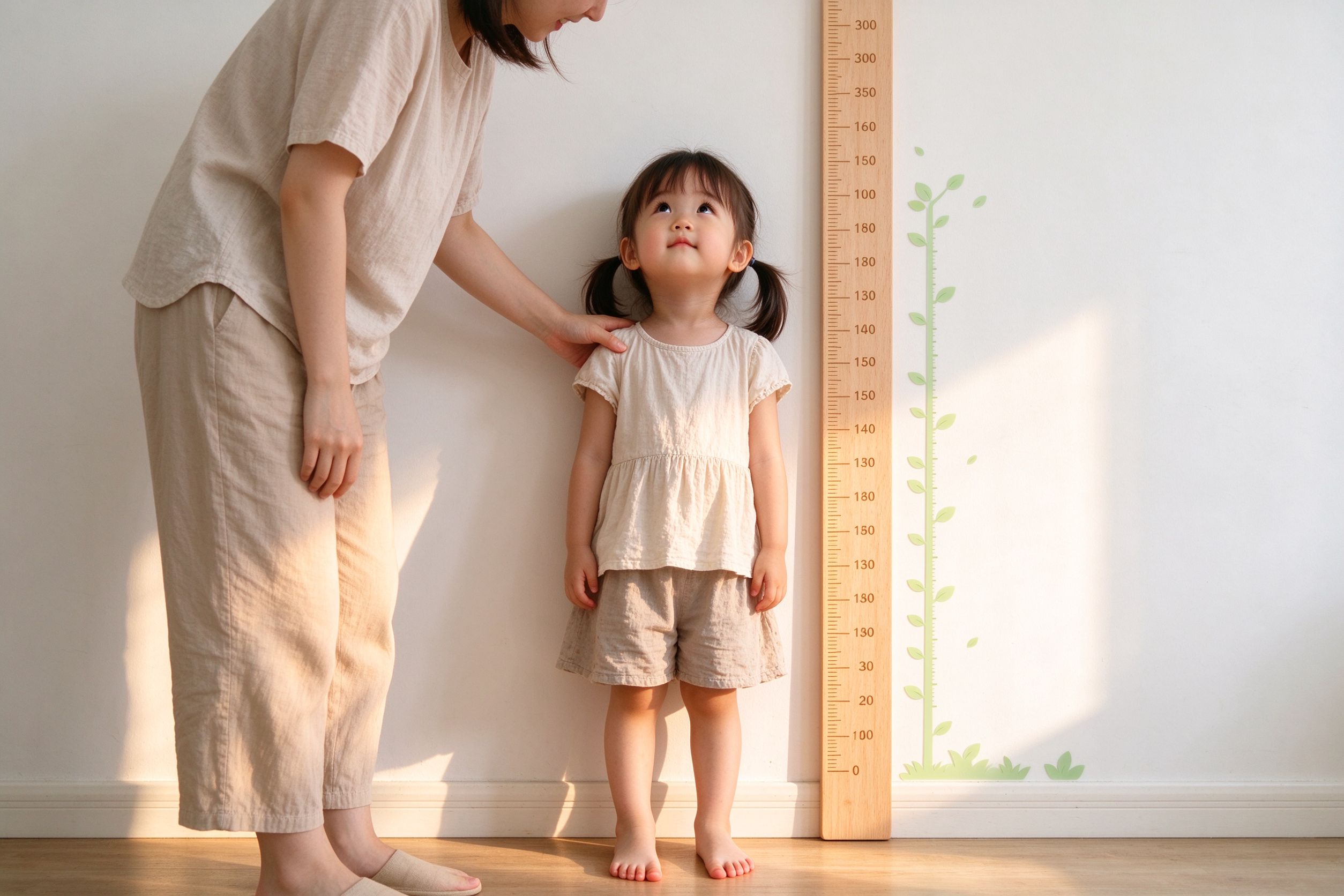
What mid-parental height is
The mid-parental height method — also called the Tanner method after the pediatrician who popularized it — is the standard screening formula used in clinics around the world to estimate a child's likely adult height. It is built on a simple, robust observation: adult height is strongly hereditary, and a child's expected height sits very close to the average of the two parents' heights, adjusted for sex. Boys tend to be taller than girls on average, so the formula adds a fixed offset for boys and subtracts it for girls.
The tool you will find on our Height Predictor page implements the classic formula. For a boy: add the mother's and father's heights in centimeters, add 13, and divide by two. For a girl: add both heights, subtract 13, and divide by two. The result is called the target height — the point around which the child's adult height is most likely to land.
Because heights are usually measured in centimeters in clinical practice, the tool works in centimeters, but the same arithmetic applies in any unit as long as both parents use the same one. If you prefer feet and inches, simply convert both parents to the same unit first.
A worked example
Let us make it concrete. Suppose the mother is 165 cm and the father is 178 cm, and the baby is a boy. The calculation runs: 165 + 178 = 343; 343 + 13 = 356; 356 ÷ 2 = 178 cm. That is the target height. Now suppose the same couple is expecting a girl: 343 − 13 = 330; 330 ÷ 2 = 165 cm.
Notice how the boy's target ends up essentially equal to the father's height and the girl's target equal to the mother's. That is not a coincidence — with average parents, children tend to regress toward the family average, which is why tall families and short families both produce children closer to their own mid-parental line over generations.
The most important detail is the one people usually skip: the target is the middle of a distribution, not a promise. A child rarely lands exactly on the target. The tool therefore reports two ranges alongside it.
What the range really means
Our Height Predictor shows a 68% range of ±5 cm and a 90% range of ±8.5 cm around the target. These numbers come from the population statistics behind the method: if you measured thousands of children with the same mid-parental height, about 68% would finish within five centimeters of the target, about 90% within 8.5 centimeters, and roughly 5% would finish outside even the wider band.
Why is the range so wide? Because height is a classic polygenic trait — hundreds of gene variants each nudge it a little, like many hands turning a dial. On top of genetics, childhood nutrition, sleep, illness and physical activity each contribute a little more or less. The honest way to read the prediction is: 'most likely near the target, very likely somewhere inside the wider band, occasionally outside it.'
This honesty is why we refuse to show a single 'exact' number as the headline. A predictor that quotes one precise centimeter is selling certainty it does not have; a predictor that quotes a range is telling you the truth.
Beyond genetics: what parents can actually influence
Genetics sets the window; lifestyle fills it in. The most consistent evidence points to three levers. First, nutrition: chronic undernutrition during childhood reliably shaves centimeters off the genetic potential, while a balanced diet helps a child reach it. Protein, calcium, vitamin D and zinc all matter, but no single 'growth food' beats an overall balanced diet.
Second, sleep: growth hormone is released in pulses during deep sleep, and children who consistently get too little sleep across their growing years tend to track at the lower edge of their range. The bedtime is not the whole story, but it is a real one. Third, physical activity: regular movement — especially weight-bearing play — supports healthy bones and posture, which show up in the final measured height.
The reassuring news for parents: these factors mostly help a child land toward the top of their genetic range, not beyond it. You cannot add ten centimeters with perfect parenting, and you rarely lose more than a few with imperfect ones. The realistic job is to give the body what it needs and let the genes do the rest.
Tracking growth instead of chasing one number
The mid-parental method is a screening tool, not a prophecy. The most useful thing you can do is combine it with real growth tracking: our Growth Percentile Calculator compares your baby's weight and length against WHO references month by month. A child who stays on roughly the same percentile band across visits is showing the healthy pattern; a sudden crossing of two or more bands in either direction is a reason to talk to your pediatrician, not to panic.
Clinics add a second, much more precise method when needed: the bone-age X-ray, usually done between ages 9 and 14, which estimates how much growth plate remains. That is the most accurate clinical prediction available — and even it comes with a margin of error.
So use the predictor for what it is: a quick, evidence-based conversation starter and planning tool. Then let the growth charts and your pediatrician do the long-term watching. That division of labor is exactly how the tool was designed.