A legend older than most countries
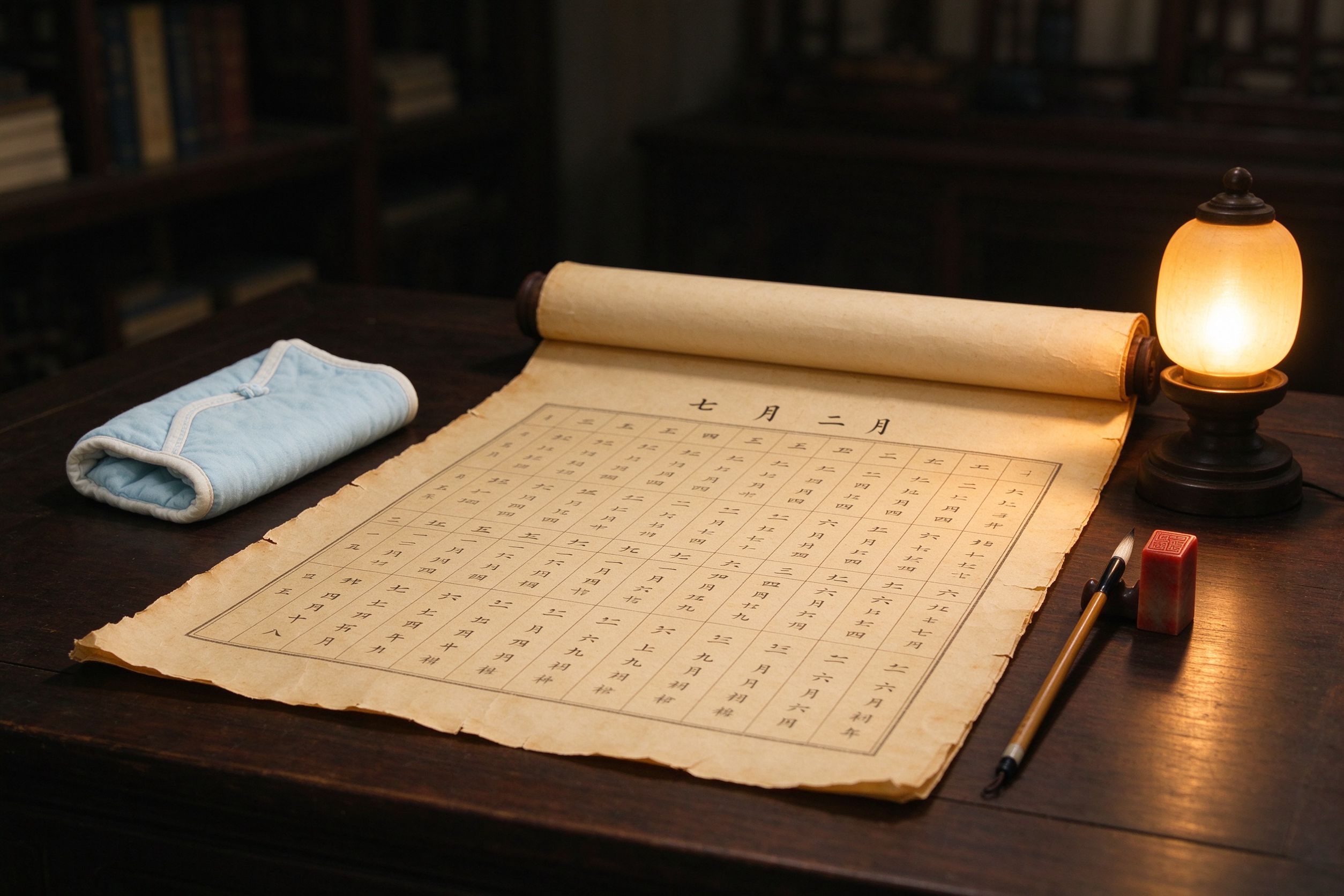
The Chinese gender chart — widely known in Chinese as 清宫表, the 'Qing Palace table' — claims a pedigree that would impress any marketer. The legend says the table was discovered in the archives of the Forbidden City during the Qing Dynasty, allegedly carved on a jade tablet and used by the imperial household to predict the sex of royal babies. The supposed date of origin pushes it back centuries, which is part of its charm: it feels like a relic of living history rather than a viral spreadsheet.
Whether the jade-tablet story is literally true is unknowable — no contemporary Qing record confirms the artifact, and most historians treat the origin tale as folklore. What is certain is that the table has circulated in Chinese communities for generations, crossed to Taiwan, Hong Kong, Southeast Asia and the worldwide diaspora, and today exists in hundreds of digital versions, including our own Gender-Lunar Calculator.
Its endurance is the real story. A table with no scientific basis has survived three centuries because it is fun, shareable and deeply embedded in family culture. Understanding that is the first step to using it well.
How the chart actually works
The table is a grid: 28 rows of maternal lunar ages (from 18 to 45) down one side and 12 columns of lunar months across the top. Each cell says 'boy' or 'girl'. Two coordinates decide the cell. The first is the mother's lunar age at conception — not her Western age. Chinese tradition counts age differently: a baby is 1 at birth, and everyone gains a year at the lunar new year. The chart's age is '虚岁' (nominal age), calculated as conception year − birth year + 1, where all years are lunar.
The second coordinate is the lunar month in which conception occurred — not the calendar month. The lunar year has twelve months of roughly 29–30 days, plus an occasional leap month inserted to stay aligned with the seasons. Tradition handles a leap month with a simple rule: if conception fell in the first half of the leap month, count it as the previous month; if in the second half, count it as the next month.
Our tool implements exactly this logic. You enter the mother's lunar birth year, the lunar conception year, and the lunar conception month, and it computes 虚岁, applies the leap-month rule, and highlights the cell.
Step-by-step: how to use our calculator
Step one: find the mother's birth year and the conception year in the lunar calendar. If you only know Gregorian dates, use any reliable lunar calendar converter first. Step two: enter both years and pick the lunar conception month. Step three: if the conception month is a leap month, choose whether the conception fell in its first or second half. Step four: press the button and read the highlighted cell — the chart's traditional answer.
A worked example: a mother born in lunar 1992 conceives in lunar 2026, in the 6th lunar month. Her 虚岁 is 2026 − 1992 + 1 = 35. The table's cell for age 35, month 6 gives the traditional prediction. If instead conception happened in a leap 6th month during its second half, the same age would be paired with month 7.
One honest caveat from our tool page: the calculation of 虚岁 itself has regional variants. Some traditions count from the moment of conception (which would add roughly 1 year plus 9 months), others from birth. The formula we use — conception year minus birth year plus one — is the most commonly cited version and the one used by most digital charts.
What science actually says
Researchers have tested the chart. Independent analyses compare the table's predictions against large sets of real births, and the consistent finding is accuracy indistinguishable from a coin flip — right around 50%. One often-cited study from Taiwan in the 1990s found about 50% agreement, and replications since then have not moved the number. That is exactly what you would expect if the table had no real mechanism.
This is not a failure of the table; it is a feature of the question. Human sex ratio at birth is roughly 105 boys per 100 girls worldwide, so even a broken predictor can 'get it right' about half the time. The chart cannot do better than biology's baseline because nothing in a calendar table interacts with sperm or chromosomes.
We state this plainly on the tool page, and we mean it: enjoy the chart as heritage and entertainment, and never base a medical decision on it. For actual determination, the options are a DNA blood test from about 10 weeks or the mid-pregnancy ultrasound around 18–20 weeks.
Making it a celebration, not a verdict
Used honestly, the chart is one of the best social props a pregnancy can have. It turns the long wait into a ritual: grandparents ask, relatives debate, and every family has a story of 'the table was right with our second one'. At a gender reveal party, pair the chart with our Old Wives' Tales Quiz for a folklore double-header — then reveal the ultrasound answer with a cake or balloons.
A lovely tradition is to record the chart's prediction in the baby book next to the actual sex at birth, and let the future child enjoy the comparison. Our Zodiac & Constellation calculator adds the complementary astrology flavor: the baby's Chinese zodiac animal and five-element year. Together, the three folklore tools make a complete 'predictions page' for the baby album.
The chart's real gift is not prediction — it is togetherness. Three centuries of families have used it to turn waiting into wondering, and wondering into conversation. That is a tradition worth keeping, precisely because we all know the answer arrives anyway.